
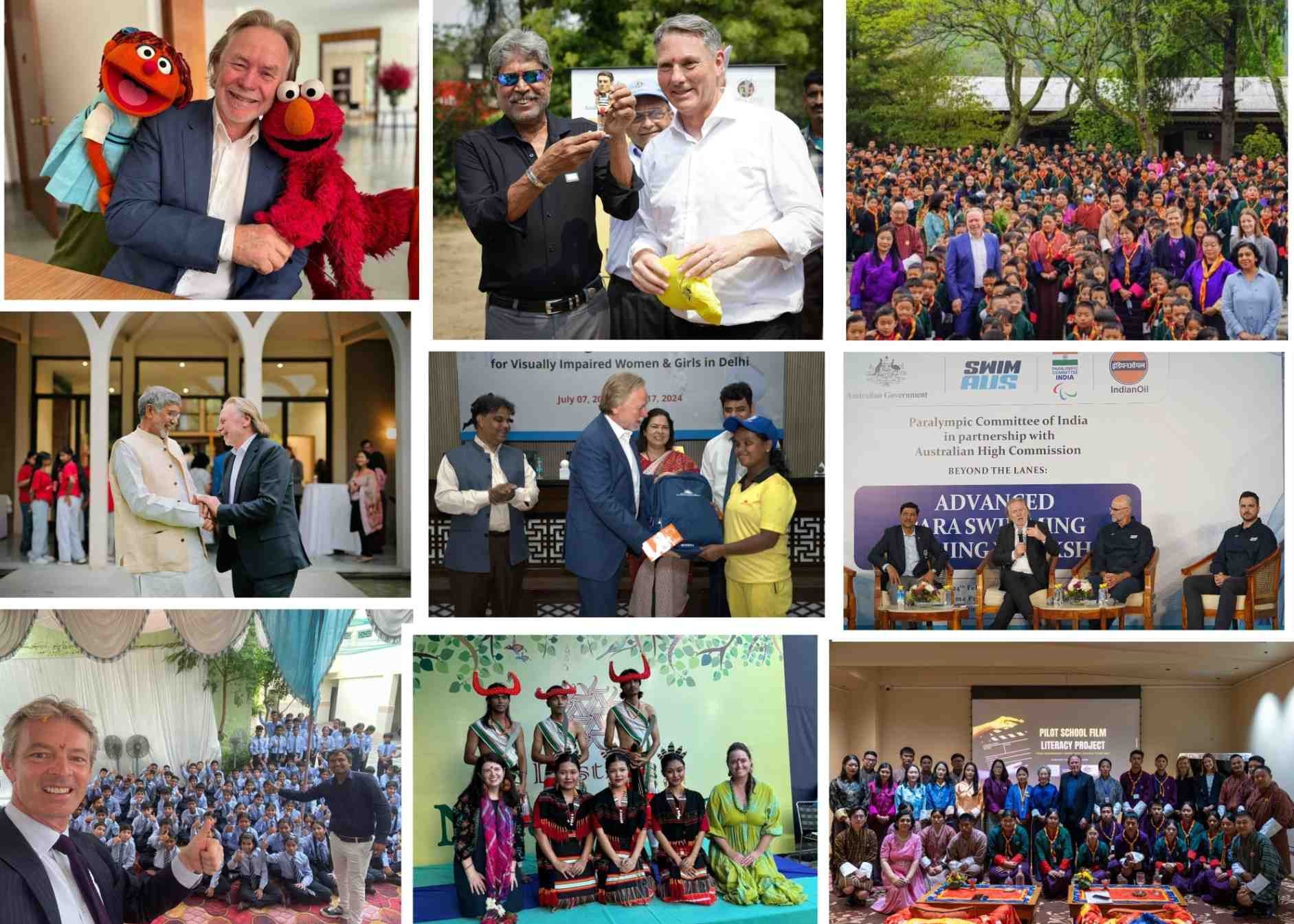
New Delhi and Bhutan Direct Aid Program
The Direct Aid Program is a small grants program in India and Bhutan funded by Australian Government and managed by the Australian High Commission in New Delhi and the Australian Consulate-Generals in Bengaluru, Chennai, Kolkata and Mumbai (India). Through the Direct Aid Program, we work with local development organisations on projects that achieve strategic and sustainable outcomes strengthening Australia-India bilateral relations.
Direct Aid Program funding is available to non-government organisations (NGOs) and social enterprises engaged in development activities. The project activities and outcomes should reflect and strengthen the social, development and cultural ethos and Australia’s partnerships with India and Bhutan.
2026-27 New Delhi Direct Aid Program: Applications now open
The Australian High Commission invites applications from eligible organisations in India and Bhutan for the 2026-27 Direct Aid Program funding round. We seek projects that-
- Deliver impact- Support practical, locally driven initiatives that address clearly evidenced community needs and deliver measurable , sustainable outcomes.
- Advance shared priorities- Promote collaboration in areas where Indian priorities and Australian capabilities intersect, including (not limited to) climate resilience, inclusive health and education, empowerment and skill enhancement, and sport for development.
- Strengthen inclusion- Embed gender equality, disability equity, social inclusion, child protection and other safeguarding principles throughout project design and delivery.
- Build lasting partnerships- Foster enduring connections between Australian and Indian or Bhutanese institutions, including governments, universities, civil society, businesses, alumni and community organisations.
- Demonstrate influence and accountability- Generate credible evidence and compelling stories that show development results, reinforce Australia’s values and protect public confidence in the program.
Applicants may apply for funding of up to INR/BTN 25,00,000 per project.
How can we apply?
All Direct Aid Program applications must be submitted through our online grants management system SmartyGrants. The portal operates on a web-based platform and can be accessed from anywhere with an internet connection. For the India applicants, information on Foreign Contribution (Regulation) Act (FCRA) validity and financial audit statements for the previous two years is mandatory for all applicants.
To start a new application-
India applicants please click on the link https://dap.smartygrants.com.au/NDLI_DAP2026-27
Bhutan applicants please click on the link https://dap.smartygrants.com.au/Bhutan_DAP2026-27
The last date for filing application is Wednesday 11 November 2026 end of day Indian Standard Time.
For any further queries, please write to [email protected]
Eligibility Criteria
- Indian projects must be located in Delhi, Haryana, Himachal Pradesh, Jammu and Kashmir, Ladakh, Punjab, Uttarakhand and/or Uttar Pradesh or Bhutan
- The project must deliver strong developmental outcomes that are clearly defined, specific, achievable, and sustainable
- The project timeline should be 12-months or less
- Indian applicants must adhere to local legislation including Foreign Contribution (Regulation) Act (FCRA) requirements
Applications must:
- be submitted through the online grants management system, SmartyGrants
- include a clear, fully itemised, and fully costed project budget
- clearly outline the development benefits of the proposal
- demonstrate the applicant’s capability and capacity to manage any identified project-related risks
- demonstrate soundness of the project's objectives and design
- demonstrate that the project is technically feasible and practical
- include a plan for project advocacy, promotion and dissemination in coordination with the Australian High Commission
We will generally NOT fund the following:
- staff salaries
- loans, cash grants or micro-credit schemes or projects that involve the return of money
- commercial ventures, purchase of major assets, e.g. vehicles, or property
- international travel, unless fundamental to the project outcome
- sponsorship of major sporting tournaments or cultural displays that do not have a clear developmental benefit
- construction activities
- routine, recurring or running costs and administrative expenses including office rental and utility costs
In some cases, limited Direct Aid Program funding can be used to cover professional fee/consultancy costs for professional and advisors exclusively for their work on the project. The program can also support domestic travel expenses when they are directly related to project implementation. However, such funding should be in small proportion relative to the overall project and should not constitute a major cost component.
Selection process
The applications will be assessed against the key objectives and eligibility criteria. The Committee will give particular consideration to projects that: a) demonstrate a clear and substantive link to Australia; b) advance Australia ‘s bilateral priorities and support broader Australia-India or Australia-Bhutan objectives; and c) include a credible sustainability, communications and advocacy plan that maximises the project’s long-term impact and visibility.
Kindly note that the Direct Aid Program Committee will not provide any direct or detailed feedback to applicants not selected. The decision on the application will be communicated through SmartyGrants or through email from [email protected]
Should your project be successful, you will be required to:
- sign a contract specifying the terms and conditions of the grant
- follow all due diligence requirements of the Australian High Commission including providing reference details and FCRA designated State Bank of India account details where the funds will be posted (only for India-based organisations)
- keep full financial records of all expenditure, including receipts
- submit a mid-term and final project completion report
- strictly adhere to Department of Foreign Affairs and Trade’s Child Protection Policies while implementing the project
- maintain timely and regular project related correspondence with the Australian High Commission
- facilitate a visit by Australian High Commission representatives to the project site when requested.
Partner obligations
We require a high degree of transparency and accountability in all projects. Recipients of DAP funding must ensure that the work conducted in relation to the project is undertaken in a safe manner and complies with all applicable local laws, standards and policies that relate to health and safety.
The Australian Government does not tolerate the exploitation, abuse or harassment of children or adults. For projects likely to involve contact with vulnerable people, the applicant must comply with the Australian Department of Foreign Affairs and Trade’s Child Protection Policy and/or Preventing Sexual Exploitation Abuse and Harassment (PSEAH) Policy. DAP recipients are expected to apply an appropriate policy commensurate with the level of risk associated with the activity and their organisation. Recipients will be asked to demonstrate that they have a Child Protection and/or PSEAH policy or other documented policies and procedures, including, reporting and investigation procedures to manage these risks.
The Australian Government is fully committed to full implementation of UN Security Council Resolutions relating to sanctions, including United Nations Security Council (UNSC) Resolutions 1373 (2001) and 1267 (1999), 1989 (2011) and 2253 (2015) and related resolutions against the financing of terrorism. Consistent with applicable Australian laws, the High Commission seeks to take reasonable precautions, and to exercise due diligence, to ensure that none of its funds are provided, directly or indirectly, to individuals or entities designated by the UN Security Council, its committees or the Australian Government for targeted financial sanctions, or otherwise used to provide support to individuals or entities associated with terrorism.
Australian Direct Aid Programs elsewhere in India
If the project is in Goa, Gujarat, Rajasthan and/or Maharashtra, queries should be directed to the Australian Consulate-General in Mumbai at [email protected]
If the project is in Odisha, Andhra Pradesh, Kerala, Tamil Nadu and the Union Territories of and the Andaman & Nicobar Islands, Lakshadweep, and Puducherry., queries should be directed to the Australian Consulate-General in Chennai at [email protected]
If the project is in Madhya Pradesh, Chhattisgarh, Karnataka and/or Telangana, queries should be directed to the Australian Consulate-General in Bengaluru at [email protected]
If the project is in Arunachal Pradesh, Assam, Bihar, Jharkhand, Manipur, Meghalaya, Mizoram, Nagaland, Sikkim, Tripura and/or West Bengal, queries should be directed to the Australian Consulate-General in Kolkata at [email protected]